


The Manager Blind Spot: Your Frontline Leaders See Distress First
Your managers see the early signs of distress weeks before anyone self-refers. Most programs waste that signal. Here's how to build one that receives it.

Before You Renew: 7 Questions Every Benefits Leader Should Ask Their Mental Health Vendor
The metrics vendors lead with measure activity, not improvement. Seven questions to ask your mental health vendor before you renew, so you can tell the difference.

The Problem Isn't That We're Over-Therapized. It's That We're Under-Optioned for culture we live in.
Dr. Sarah Adler react’s to the New York Time’s opinion article “Maybe You Don’t Need Therapy” by arguing that we’re not over-therapized; we’re under-optioned. She asserts that we need the missing middle: mental health coaching.

What "Right Level of Care" Actually Means — and Why It's Not About Limiting Access
Health plans have spent years optimizing for utilization. Wave's model optimizes for something different: getting each member to the level of care that will actually work, then tracking whether it did.

What NBC-HWC Certification Actually Means, and Why Wave Treats It as the Floor
"Coach" is an unprotected title. Anyone can use it. Here's what the NBC-HWC credential actually requires, why it matters specifically for mental health work, and what Wave builds on top of it.

Wave Launches Clinical Innovation Lab to Extend Coach-Delivered Care to Underserved Populations
New program establishes a disciplined process for expanding coaching into complex clinical areas, with early pilots focused on expanding neurodiversity coverage to include ARFID across the lifespan.

Auditable Outcomes: How We Measure Whether Wave Actually Works
Wave's clinical outcomes are measured continuously, validated against published research, and auditable by partners. Here's what we measure, how, and what the data shows.

Transdiagnostic Mental Health: Why Wave Focuses on Mechanisms, Not Categories
Wave's clinical model targets the underlying mechanisms of distress — including avoidance, emotion dysregulation, and cognitive rigidity — across diagnostic categories. Here's why a transdiagnostic approach reaches more members and produces better outcomes.

Mental Health Coaching at Wave: Our Model, Explained
Wave's mental health coaching model is built around National Board Certified coaches, measurement-based care, an integrated between-session experience, and care navigation. Here's what makes it different from other digital mental health platforms.

Mental Health Coaching vs Therapy: Understanding Wave's Approach
Confused about mental health coaching vs therapy? Discover the distinctions, benefits, and how Wave's coaching-first model provides effective, accessible care.

The Unseen Gap: What Happens Between Mental Health Sessions?
Discover how Wave's 'Bytes' fill the critical 'between-visit' gap, boosting engagement and improving outcomes. Learn about our unique approach.

Beyond the Black Box: How Wave Delivers Auditable Mental Health Outcomes
Uncover how Wave’s continuous measurement and transparent reporting eliminate the 'black box' problem in mental health, proving ROI with auditable outcomes.

Beyond the Waitlist: Wave's Stepped Care Model for Mental Health
Discover how Wave's stepped care model efficiently matches mental health intervention intensity to individual need, ensuring timely, effective support and reducing the burden of the access crisis.

The Myth of "More": Why Unlimited Sessions Won't Fix Your Employee Mental Health Strategy
Unlimited therapy sessions don't guarantee better outcomes. Learn why precision, not volume, is what actually drives employee mental health improvement.

Why 45 Days is Enough: The Clinical Data Behind Mechanism-Targeted Coaching
Discover how Wave's coaching-led, transdiagnostic model drives 73% clinically significant symptom reduction in 30-45 days for engaged users. Explore the clinical outcomes data

Beyond the Diagnosis: Why Paying for Mental Health Needs a Mechanistic Shift
Discover how Wave's transdiagnostic model and continuous measurement-based care deliver proven behavioral health outcomes and network adequacy for health plans.
Wave’s Public Comment on the FDA’s Request for Feedback on Generative Artificial Intelligence-Enabled Digital Mental Health Medical Devices.
We submit the following comments to support a regulatory framework that ensures patient safety while enabling responsible and equitable innovation.
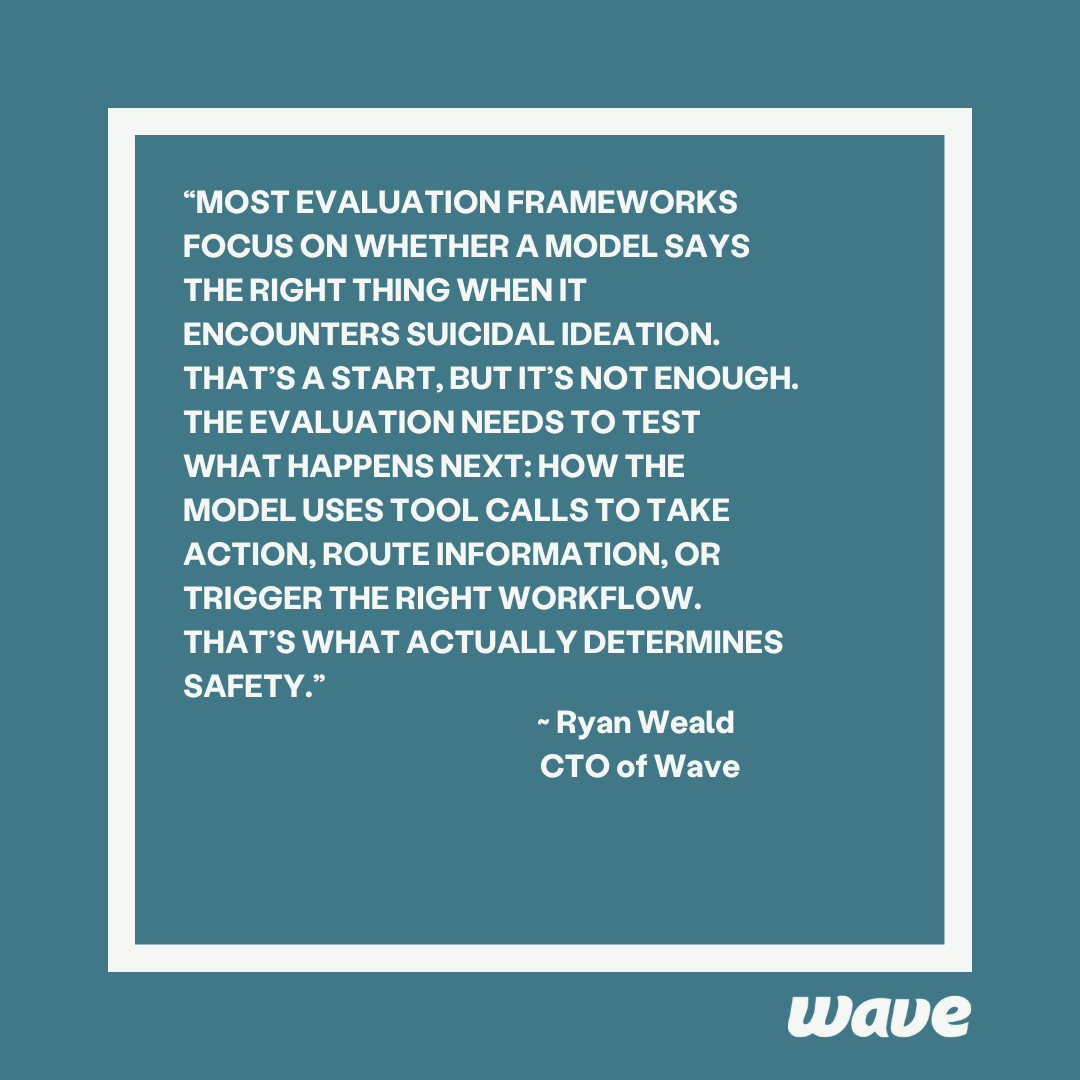
Tool Calling is the Real Safety Feature
Most evaluation frameworks focus on whether a model says the right thing when it encounters suicidal ideation. That’s a start, but it’s not enough. The evaluation needs to test what happens next: how the model uses tool calls to take action, route information, or trigger the right workflow. That’s what actually determines safety.

Simulation is the Lab: Building Safe, Measurable AI for Mental Health Care
To earn trust in mental health care, AI must be tested safely and measured transparently, just like self-driving cars. Wave CTO Ryan Weald explains why large-scale simulation and shared benchmarks are the key to building responsible, effective mental health AI.
Wave Life’s Coaching Model Delivers Clinically Significant Mental Health Gains, Not Just for Subclinical Presentations
New peer-reviewed research published in JMIR Formative Research confirms that Wave Life’s coaching-first model drives rapid, measurable improvements in anxiety, depression, and stress—often within 30 days. The study shows that evidence-based coaching can deliver clinically significant outcomes at scale, even for individuals with severe symptoms.